Concrete and interlocking stone are the two most popular premium driveway and patio surfaces in Calgary. Both look great in photos. Over a 20-year span in Alberta’s climate, they perform very differently. Here is a straight comparison across cost, durability, maintenance, and long-term value.
Cost Comparison: Concrete vs. Interlocking Stone in Calgary
Interlocking stone (also called pavers or interlock) typically costs significantly more to install than concrete – and the gap is wider in Calgary than in milder climates because Alberta’s freeze-thaw cycles require additional base preparation for pavers to remain level over time.
| Surface | Installed Cost / sq ft | Double Driveway (70 sq m) | Patio (30 sq m) |
|---|---|---|---|
| Broom finish concrete | $10–$15 | $10,500–$16,000 | $4,500–$7,000 |
| Exposed aggregate concrete | $14–$22 | $14,500–$23,000 | $6,000–$9,500 |
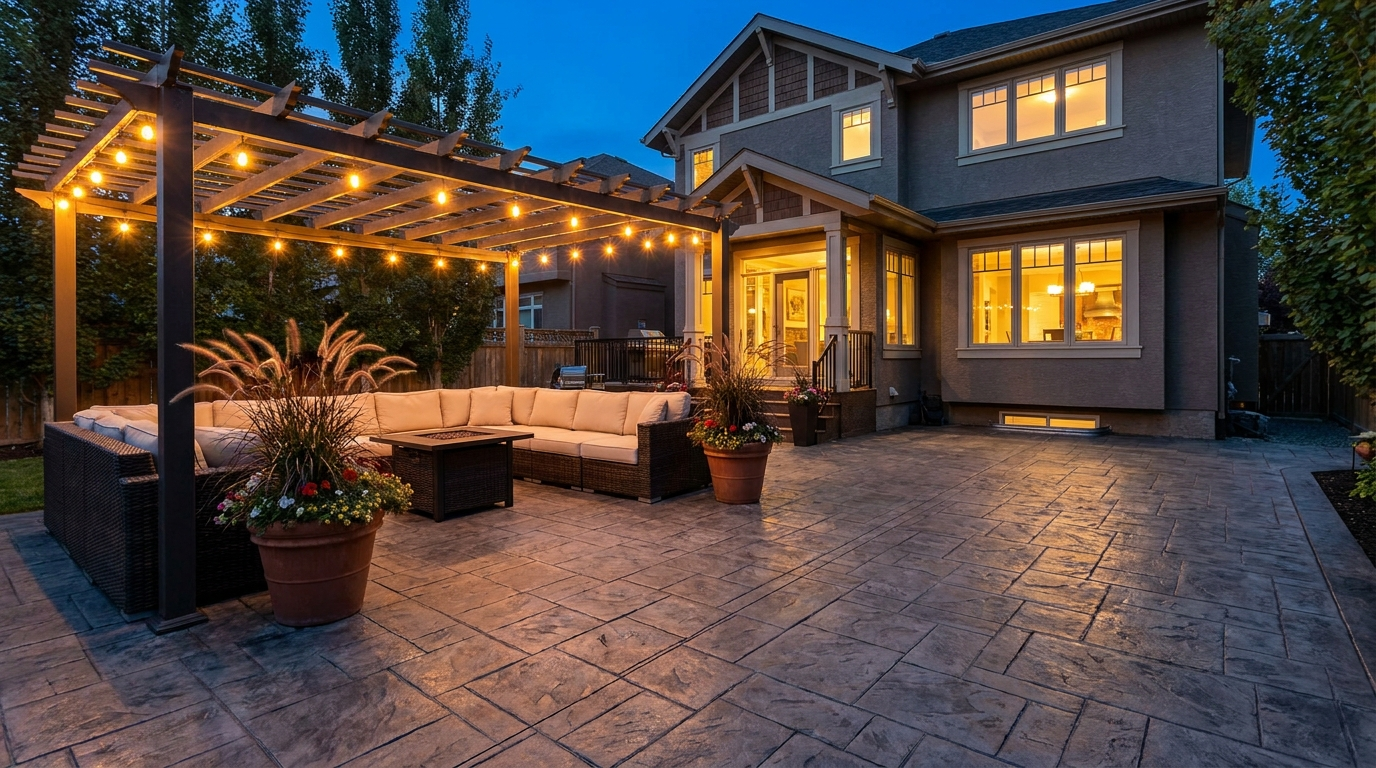
| Stamped concrete | $18–$30 | $18,500–$31,000 | $7,500–$13,000 |
| Standard interlocking stone | $22–$35 | $23,000–$36,000 | $9,500–$15,000 |
| Premium pavers (natural stone, large format) | $35–$55+ | $36,000–$57,000+ | $15,000–$24,000+ |
These are general Calgary market references for 2026. Your actual quote depends on site conditions, access, materials, and scope. Always verify pricing directly with your contractor.
How Calgary’s Climate Affects Both Surfaces
Calgary averages more than 100 freeze-thaw cycles per year. This is where the comparison between concrete and interlocking stone gets complicated – and where most online advice from milder climates becomes misleading.
Interlocking Stone in Calgary Winters
Pavers need to move independently to accommodate freeze-thaw expansion. This requires a deep, well-draining base – typically 300 to 450 millimetres of compacted granular material in Calgary’s climate, compared to 150 millimetres for concrete. That extra base depth is one reason interlocking installation costs more here than in Vancouver or Toronto.
Even with a proper base, interlocking stone in Calgary tends to heave over time. Individual pavers shift, creating uneven surfaces that need to be reset. Clay-heavy soils common in some Calgary neighbourhoods accelerate this movement. Most paver installers recommend professionally re-levelling every five to ten years.
Concrete in Calgary Winters
Concrete moves as a monolithic slab rather than individual units. Properly installed concrete – 32 MPa with six percent air entrainment on a 150-millimetre compacted base – handles freeze-thaw cycles well. The risk is cracking at control joints or from subsidence, which is why joint placement and base preparation are critical. A cracked concrete slab is a repair job; a shifted interlocking patio is a re-levelling job. Both require attention, but concrete problems tend to be more visible and concrete repairs can be more expensive for large areas.
Maintenance: Which Is More Work in Calgary?
| Task | Concrete | Interlocking Stone |
|---|---|---|
| Sealing | Every 3–5 years | Every 2–4 years (polymeric sand refresh) |
| Joint maintenance | Control joint filling if cracked | Polymeric sand re-application every 3–5 years |
| Re-levelling | Not applicable (monolithic) | Every 5–10 years in Calgary clay soils |
| Weed control | Minimal | Ongoing – joints attract weed growth |
| Snow removal | Easy – smooth surface, no joints to catch plow | Careful required – metal plows can chip or displace pavers |
| Stain treatment | Penetrating sealer helps; oil stains are difficult | Individual pavers can be removed and replaced |
Interlocking stone requires more active maintenance in Calgary than most homeowners expect. The joints need polymeric sand refreshed, weeds need managing, and paver re-levelling is a realistic maintenance cost over a 20-year span. Concrete’s maintenance is simpler but the consequences of neglecting it – particularly skipping sealing – accumulate faster in Alberta’s climate.
Where Interlocking Stone Has an Advantage
Pavers genuinely outperform concrete in two specific situations. First, areas with drainage problems: interlocking stone can be permeable, allowing water to filter through the joints rather than pooling on the surface or running off toward a foundation. Permeable paver systems are an engineered solution for grading-challenged lots. Second, design flexibility: pavers come in a wider variety of colours, textures, shapes, and patterns than any poured concrete finish. If a specific aesthetic matters more than lifecycle cost, premium pavers can achieve looks that concrete cannot replicate exactly.
Pavers also allow selective replacement – if one section fails or a single paver cracks, it can theoretically be lifted and replaced without affecting the rest of the surface. In practice, matching old paver colour and weathering is difficult, but the option exists.
Where Concrete Has an Advantage
Concrete is more structurally stable for driveways with heavy, regular vehicle loads. RV pads, heavy truck access, and commercial vehicle parking are better suited to a continuous concrete slab than individual pavers, which can shift under concentrated loads. Concrete also performs better under a snowplow – blades, salt spreaders, and snow blowers do not need to avoid metal-on-paver contact the way they do with interlocking surfaces.
For most Calgary homeowners, concrete is also simpler to get right the first time. A properly mixed and placed concrete slab is less sensitive to installation error than pavers, which rely on precise base levelling and joint material to maintain their appearance over time.
Which Is the Better Investment for Calgary Homeowners?
For most driveways, walkways, and mid-sized patios in Calgary, concrete – particularly exposed aggregate or stamped – offers better long-term value than standard interlocking stone. It costs less to install, requires less active maintenance, and performs more predictably through Alberta winters. Decorative concrete finishes close the aesthetic gap significantly.
Interlocking stone is worth the premium if you have a specific design vision it uniquely satisfies, a drainage problem that permeable pavers solve, or a limited area where the higher cost per square foot is manageable. In those cases, hire a contractor with specific Calgary paver experience and budget for ongoing maintenance.
Frequently Asked Questions
Does interlocking stone add more value to a Calgary home than concrete?
The evidence on this is mixed. Both surfaces add curb appeal and are perceived positively by buyers. Premium pavers can command a slight premium in upscale neighbourhoods, but the difference is typically smaller than the cost difference in installation. A well-maintained concrete driveway in good condition adds equivalent or greater value in most Calgary real estate contexts.
Can interlocking stone be installed over an existing concrete driveway?
Technically yes, but it is generally not recommended by reputable contractors. The existing concrete creates a rigid base that does not flex appropriately for pavers and can telegraph any existing cracks or heaving into the paver surface above. Most installers prefer to remove existing concrete and build a proper base from subgrade up.
How long does interlocking stone last in Calgary?
Individual pavers can last 25 to 40 years. The installation – base, joints, and layout – typically needs professional attention every five to ten years in Calgary’s climate to remain level and well-drained. The surface material itself is durable; what fails is usually the system around it.
Comparing concrete and interlocking stone for your Calgary property? Get a free site assessment from Rosko Concrete – Jeff will walk your property, discuss both options honestly, and give you a written quote. We specialize in concrete driveways, exposed aggregate, stamped concrete patios, and outdoor living surfaces across Calgary and area.